Home / Books / The Architecture of Truth
Signal · The framework
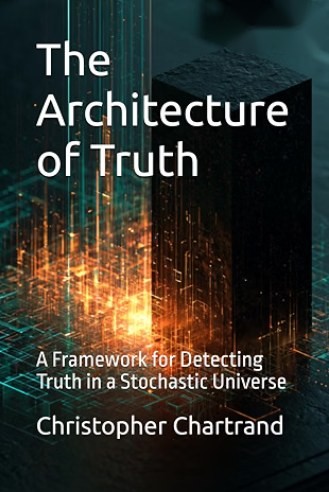
The Architecture of Truth
A Framework for Detecting Truth in a Stochastic Universe
Our brains are survival filters, not truth detectors. This book is about working within that limit.
A framework for telling signal from noise, written for systems thinkers, rationalists and anyone ready to give up performed certainty.
- Paperback
- 164 pages
- Published August 27, 2026
- ISBN 9798170263899
The big question
What if the brain never evolved to see reality, only to survive it?
In The Architecture of Truth, Chris runs what he calls a forensic audit of the limits of human thinking. He questions the old assumption that a lasting “ego” exists just because thoughts happen, and he replaces mystical ideas about truth with a framework based on signals and evidence, drawn from physics, mathematics, psychology and evolutionary biology.
At 164 pages, it’s written for people who like to see how an idea is built.
Ideas he names
Three terms from the book
These are Chris’s own models and terms, set out and argued in the book.
Survival filters
Chris’s term for how the brain works: it is wired to put social belonging, threat detection and saving energy ahead of seeing reality as it is.
The Complexity Tax
The cost of biological bias that, in his framework, you have to account for before you can trust what you think you see.
The 97% Agnostic Threshold
What he calls the ceiling of certainty: the highest resolution any detected truth signal can reach before it dissolves into noise.
“What if the human mind evolved not to model reality, but merely to survive it?”From the back cover of The Architecture of Truth
What’s inside
Five parts of the framework
The physics of information
Why information is physical, with measurable thermodynamic limits, and why keeping up a falsehood is an ongoing energy debt.
The evolutionary override
Spotting and disarming the “backdoors” in human thinking, including Error Management Theory, the “God of the gaps” fallacy and the pull of tribal consensus.
Metacognitive calibration
The math behind the Dunning-Kruger effect, cognitive siloing and the “curse of knowledge”.
The Empty Cup Protocol
Practical rules of thumb for stress-testing your own beliefs: steelmanning the other side, Bayesian updating and making sure words mean the same thing to both people.
The thermodynamics of integrity
Why radical honesty and letting go of ego are, in his model, the lowest-energy steady state for a mind that works well.
Is it for you?
Who this book is for
You’ll likely get a lot from it if
- you think in systems and want to see the working
- you’re a rationalist, a skeptic or a truth-seeker who distrusts easy certainty
- you like physics, math and psychology applied to everyday thinking
- your mind tends to notice patterns others miss: the book is written through what Chris calls a neurodivergent lens
It may not be what you want if
- you want a light read or a story
- you’d rather have short, standalone thoughts
- you want comfort more than a challenge
For the same ideas as short aphorisms, start with Observations.
Ideas from this book