Home / Ideas / Bayesian thinking
Ideas · Signal
Bayesian thinking
Bayesian thinking means treating beliefs as degrees of confidence, not on-off switches, and updating them in proportion to new evidence. It comes from Bayes’ theorem, published in 1763, two years after Thomas Bayes died.
The idea in three words
- Prior: how likely something seemed before the new evidence.
- Evidence: what you just learned, and how much more likely it is if the belief is true.
- Posterior: your updated confidence. It becomes the prior next time.
A simple example: the smoke alarm
Say a kitchen fire happens once in every 1,000 times you cook. Your smoke alarm catches every real fire, but it also goes off for burnt toast 5% of the time. Out of 1,000 cooking sessions, that’s about 1 real fire and about 50 toast alarms. So when the alarm sounds, the chance of a real fire is about 1 in 51, or 2%.
That doesn’t mean you ignore the alarm. It means the alarm alone tells you less than it feels like it does. Forgetting how rare something is to begin with is called the base-rate trap.
How to use it day to day
- Start with how common something is before you react to one case.
- Move in steps. Strong evidence moves you a lot; weak evidence a little.
- Never get to 0% or 100%. If you can’t be moved, you’ve stopped thinking.
Philip Tetlock’s research on forecasting, described in Superforecasting (2015), found that the best forecasters tended to update their predictions often, in small steps.
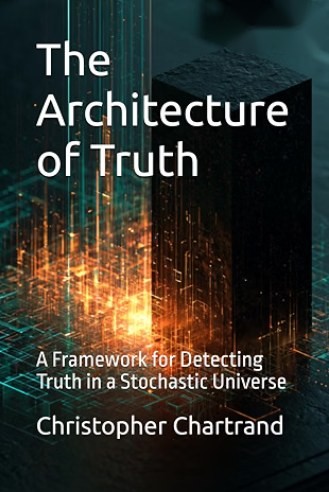
The Architecture of Truth
Bayesian updating is one of the tools in what The Architecture of Truth calls the Empty Cup Protocol, next to steelmanning and “semantic alignment.” It also fits Chris’s idea of the 97% Agnostic Threshold: in his framework, confidence can rise with evidence but never reaches complete certainty.
Sources
- Bayes, T. (1763). An essay towards solving a problem in the doctrine of chances. Philosophical Transactions of the Royal Society of London, 53. doi:10.1098/rstl.1763.0053
- Tetlock, P. E., & Gardner, D. (2015). Superforecasting: The Art and Science of Prediction. Crown.
Keep exploring