Home / Ideas / Signal vs noise
Ideas · Signal
Signal vs noise
Signal is information that tells you something real. Noise is everything that varies without meaning anything. The idea comes from communications engineering, and it applies just as well to how we read news, moods and other people.
Where the idea comes from
Engineers measure a channel by its signal-to-noise ratio: how much of what comes through is the message, and how much is static. Claude Shannon’s 1948 paper, “A Mathematical Theory of Communication,” put this on a mathematical footing and founded information theory.
Signal and noise in everyday life
| Usually noise | More likely signal |
|---|---|
| One bad day | The same feeling, week after week |
| Today’s headline | A trend that holds up over years |
| A single comment online | What people do, consistently |
| How sure someone sounds | Whether their past calls were right |
The statistician Nate Silver made a similar case in The Signal and the Noise (2012): most predictions fail because people mistake noise for signal, and see patterns that aren’t there.
Ways to hear the signal better
- Slow down your inputs. Fewer, better sources beat a constant feed.
- Look for repetition. A real pattern shows up again and again.
- Start from the base rate. Ask how often something usually happens before reacting to one case.
- Notice your own static. Fear, fatigue and the wish to belong all add noise to what you perceive.
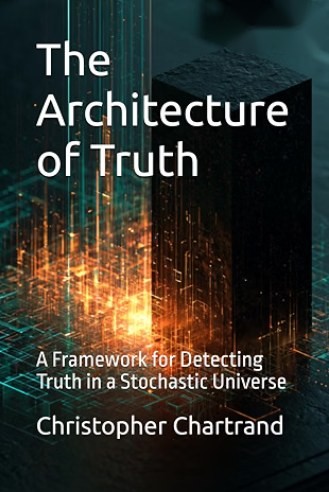
The Architecture of Truth
Signal is the middle movement of Observations and the core of The Architecture of Truth. Observations describes “the quiet precision required to distinguish genuine signal from cultural and psychological feedback loops.” The Architecture of Truth builds what Chris calls a signal-based framework for evidence, and it sets out his “97% Agnostic Threshold”: the point, in his model, beyond which signal dissolves into irreducible noise.
Sources
- Shannon, C. E. (1948). A mathematical theory of communication. Bell System Technical Journal, 27. doi:10.1002/j.1538-7305.1948.tb01338.x
- Silver, N. (2012). The Signal and the Noise: Why So Many Predictions Fail, but Some Don’t. Penguin Press.
Keep exploring